
Rules notebook
Blackjack RTP: compare the rules behind the percentage
 Partner offers · Country: United KingdomUpdated 11 November 2026
Advertising. Bonus amounts, ratings and review counts are supplied by advertisers and have not been independently verified. Check eligibility and current terms with the operator. 18+. These international campaigns have no dedicated GB offer; GB availability has not been confirmed.
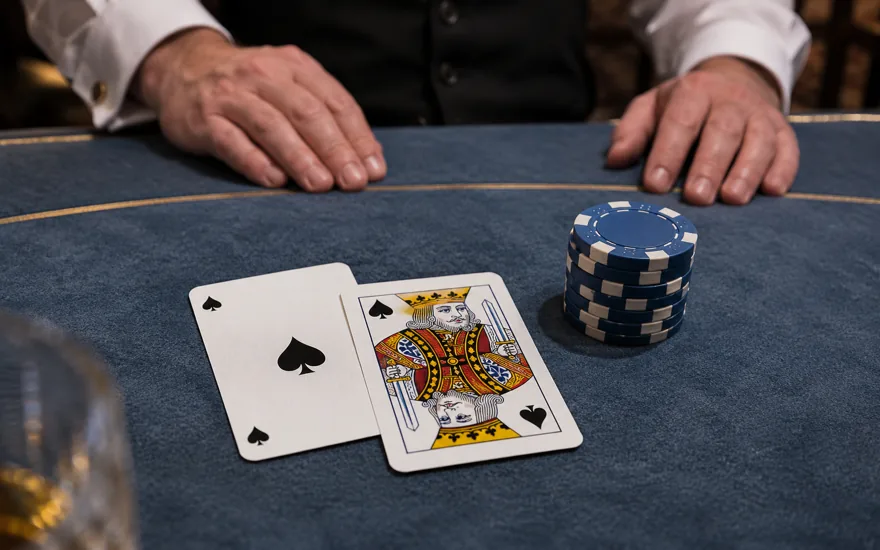


Blackjack RTP is a theoretical return for a defined game and set of player decisions. There is no single percentage covering every table, side bet or way of playing. Compare the rules and assumptions before comparing a headline figure.

What does blackjack RTP measure?
Return to player relates expected money returned to money staked under a mathematical model. It is not simply the probability of winning a hand. A winning natural, an ordinary win, a tie and a loss can settle differently, so counting winning hands alone cannot establish the return.
A quoted blackjack percentage normally carries decision assumptions. A player who always stands and a player who follows a suitable basic-strategy chart are not necessarily described by the same model. A percentage without its rule set and decision basis is therefore an incomplete comparison.
The game rules notebook distinguishes the paytable, the account balance and the payment record. RTP belongs with the game mathematics. It does not prove that a balance is withdrawable or that the cashier has already sent money to a bank.
Compare rule sets before ranking percentages
Start with the natural-blackjack payout, the number of decks, the dealer’s soft-total rule and the permitted player actions. Then check splitting, doubling and surrender conditions. A restriction can matter even when the table’s name and visual appearance closely resemble another version.
Our 3:2 and 6:5 comparison isolates the settlement of a natural. That single calculation should not be presented as the complete RTP of a table. A full return model must also account for the other possible hands and their probabilities.
Variant rules require particular care. Evolution’s Power Blackjack description says the nines and tens are removed while picture cards remain, and describes additional doubling options. A conventional full-deck chart or percentage should not be transferred to that product merely because both titles contain blackjack.
| Compare | Record | Avoid |
|---|---|---|
| Natural payout | 3:2, 6:5 or the stated variant | Treating one payout as full RTP |
| Dealer and deck rules | S17/H17 and actual deck composition | Importing a chart from another variant |
| Additional wagers | Separate stakes and returns | Using main-game RTP for side bets |
What does house edge tell you about expected loss?
For a hypothetical model returning 99.5% of total stakes on average, the complementary expected loss is 0.5%. On £200 of turnover, expected return is £199 and expected loss is £1. These figures illustrate arithmetic; they are not the verified percentage of a table recommended here.
Nor does the example mean a £200 deposit should finish at £199. Turnover is the sum of stakes, which may include money returned and staked again. A deposit only measures money added to an account, and a particular session can lose far more than its model expectation.
Compare another invented model with 98.5% return on the same £200 turnover. Its expected loss is £3. The £2 gap compares two expectations under fixed assumptions. It does not promise a £2 difference between sessions or compensate anyone for losses already incurred.
| Invented model | £200 turnover | Expected loss |
|---|---|---|
| 99.5% return | £199 expected return | £1 |
| 98.5% return | £197 expected return | £3 |
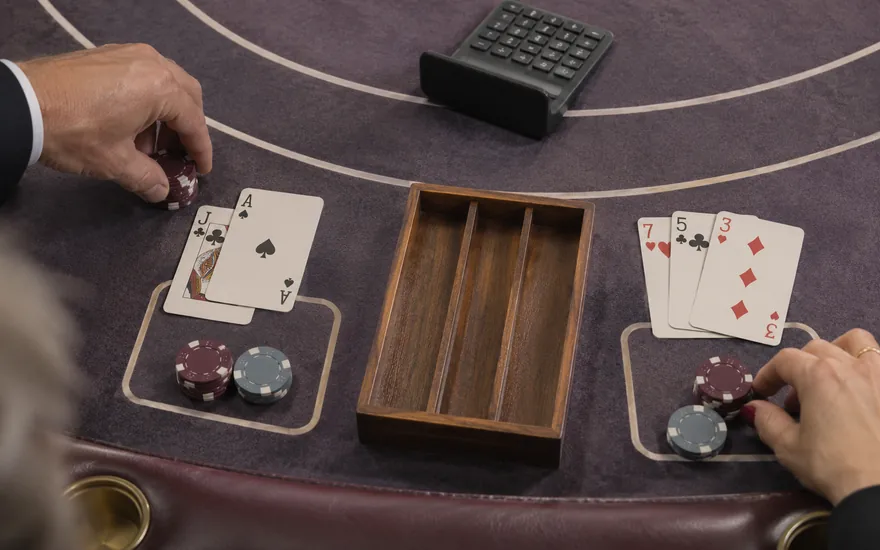
A return percentage is different from a win rate
Consider a tiny invented game with two equally likely outcomes on a £1 stake. One returns £1.90 including stake and one returns nothing. Its win frequency is 50%, while expected return is 95p, or 95%. This is an illustration, not a blackjack probability model.
The difference arises because outcome frequency and the amount returned are separate inputs. Real blackjack adds ties, natural payouts and extra stakes from actions such as splitting or doubling. A statement that someone won a certain share of hands is insufficient to reconstruct the overall return.
When comparing a published statistic, identify its denominator. Hands, initial bets, total staked money and deposited money are not interchangeable units. If a source changes units partway through a comparison, an apparently precise percentage may no longer answer the original question.
Main hands and side bets need separate figures
An optional side bet is an additional wager with its own conditions and settlement. The main game’s RTP cannot be applied to that wager without evidence. Equally, a large possible side-bet prize is not a substitute for knowing its probabilities or theoretical return.
Record each part of a hypothetical round separately: the initial main stake, any additional main-hand stakes, the side stake and the respective returns. This keeps an ordinary main-hand loss from disappearing behind a side-bet credit, or a side-bet loss from being omitted from the total.
For example, a £5 main stake returning £10 and a separate £1 losing side bet produce £4 net profit across £6 staked. The £10 credit includes returned main stake. That arithmetic is illustrative and does not describe a particular operator’s side-bet paytable.
What basic strategy can and cannot establish
A chart is specific to its rules. PlayOJO’s chart guide distinguishes deck counts, dealer soft-17 behaviour and doubling after splits. The appropriate row also depends on whether a hand is hard, soft or a pair. A total alone does not identify every decision.
Basic strategy does not turn the model expectation into a guaranteed personal result. It can describe a decision rule under assumptions; it cannot schedule the next card or prevent losses. Increasing a stake after losing changes the money exposed rather than repairing the game’s theoretical return.
The soft-18 note demonstrates why a seemingly strong total can still require different actions. It keeps the available options and dealer upcard visible, without treating one chart as a universal instruction for every blackjack variant.
Build a useful comparison record
For each table, retain the complete game name, provider, applicable rules and any published percentage with its stated assumptions. Record whether the figure covers the main game or a separate wager. If the version’s information panel differs from a marketing summary, keep that discrepancy explicit.
Do not average percentages from different variants to fill a gap. First establish whether either calculation describes the table being compared. Observed results cannot fill that gap either: a personal run of ten or a hundred hands records a sample, not an attributable mathematical specification for the game.
Finally, separate the decision to compare from the decision to spend. No percentage makes gambling a dependable source of money. If the concern is recovering a previous loss or resolving an unpaid withdrawal, return to cashier triage or independent support rather than playing more.
A mathematical model needs a decision rule
Blackjack includes choices which can change the subsequent hand and the amount staked. A model therefore needs to specify how those choices are made. A return figure without a decision basis is incomplete even if it correctly identifies the number of decks and the natural payout.
The decision basis might be described by a suitable chart or another stated policy. It must still match the game’s rules. A chart for one arrangement should not be transferred to a variant with changed deck composition or different permitted actions simply because the displayed hand totals look familiar.
Suppose a hypothetical comparison keeps the initial cards and paytable the same but changes the chosen action. The possible paths that follow will differ. That is why the action belongs among the model’s assumptions; it does not mean a player can identify and select a guaranteed winning path.
When a review supplies a percentage but not the assumptions, record the omission. Do not complete the model from a remembered chart or turn the missing explanation into a personal strategy recommendation. The available evidence may support a definition of RTP without supporting a precise figure for the particular table.
Net return and total credit are alternative accounting views
An expected return can be expressed through total amounts returned or through net changes, provided the calculation uses the same stakes and conventions throughout. Problems arise when one outcome is entered as profit while another is entered as a credit including the returned original stake.
For a hypothetical ledger, a ten-token ordinary winning stake might return twenty tokens including the original ten. Its net gain is ten. A losing stake returns nothing and has a net change of minus ten. Those are two consistent descriptions of the same accounting, not two different prize systems.
A push illustrates the distinction especially clearly. Under an illustrative rule returning the original stake without profit, the total credit equals that stake while the net change is zero. Calling the entire credit profit would inflate the apparent result even though the account merely recovered the amount reserved.
Choose a convention and keep it throughout the model or session record. Label each amount as either a total credit including returned stake or a net change after the stake. Otherwise, the arithmetic can mix unlike amounts before the probabilities are applied, even if every individual entry was copied correctly.
Extra stakes make the denominator important
Splitting or doubling can introduce additional money into a round where the rules permit those actions. A calculation based only on the initial stake can therefore answer a different question from a calculation using the total money staked. Both need their denominator identified before a comparison is meaningful.
Consider an invented round beginning with ten tokens and later exposing another ten through an allowed action. A record showing only the initial ten omits part of the amount at risk. The final credit cannot be used to describe return on total stakes unless the additional exposure is included.
This article does not assign a universal denominator to every published blackjack statistic. The source should explain its convention. A house-edge statement based on the initial wager and a return measure based on all stakes should not be treated as directly interchangeable without understanding their definitions.
For a private account enquiry, retain each added-stake entry. It can explain why the final balance differs from an expectation formed using only the first bet. The payout guide addresses the separate issue of which hand qualifies for the natural-blackjack ratio.
Card composition is more than the printed deck count
The number of decks is useful information, but it does not fully identify the cards present in every variant. A product can change the composition as part of its published rules. A model for a conventional full deck should not automatically be applied to such a product.
Evolution’s current Power Blackjack description supplies one attributable example: it describes removing nines and tens while retaining picture cards, alongside additional doubling choices. That combination illustrates why a familiar table name cannot stand in for a complete specification. The detail is about that named release, not every blackjack installation.
Removing a rank does not have an isolated effect that this guide can turn into a return figure. Deck composition, payouts and permitted decisions interact. A conventional strategy chart does not account for an altered deck simply because the familiar card values still appear on the screen; the matching model is needed.
When reading an unusual variant, identify the changed elements first and keep unknown mathematical fields unknown. A plain description of the available actions and deck composition can be useful without pretending to calculate an exact RTP from a short product summary.
Equal totals can represent different decision states
A total of eighteen can be hard, soft or a pair before any relevant split decision. A model that ignores those distinctions may assign the same action to states which the rules and an appropriate strategy chart treat differently. The displayed total alone is not a complete description of the decision point.
The dealer’s upcard and the stage of the player hand also matter to identifying the applicable chart cell. A two-card soft hand can have options which are no longer available after another card. The soft-eighteen guide explains those reading distinctions without promising a personal result.
For an illustrative model record, write the actual cards, whether an ace can still count as eleven, the dealer upcard and the actions permitted at that stage. That is more informative than a note saying only player eighteen. It preserves the condition the decision rule needs.
Use these details to check the assumptions, rather than to choose an action for an unidentified table. A calculation may be correct for a hard hand yet irrelevant to the soft hand in the record. Establish that the cards, available actions and dealer upcard match before reading its conclusion across.
Weighted averages need probabilities as well as payouts
An expected value combines possible outcomes with their probabilities. A list of possible payouts alone is insufficient. Giving equal weight to every row in a paytable would assume that all those outcomes are equally likely, which the existence of the rows does not establish.
In an invented two-outcome exercise, one result might return two tokens and another return none. Changing their probabilities changes the expected return even though the two visible payout amounts remain unchanged. The example shows what information is missing when a reader sees only the rewards.
Blackjack adds further complexity because choices can alter the path through possible hands and additional stakes. This publication does not build a full model from a handful of observed hands. A short history gives observations, not a complete probability distribution for every eligible state.
Ask where a published calculation gets its probabilities and decision assumptions. A source explaining those inputs lets you assess the model. A story about a profitable session tells you what happened to that person instead. A confident tone or several decimal places cannot supply the inputs the calculation leaves out.
A percentage cannot be estimated from the share of winning hands alone
Winning-hand frequency discards the size of each stake and settlement. A natural, an ordinary win and a result involving added stakes can have different financial effects. Two records with the same number of winning hands can therefore produce different net changes and different ratios of returns to stakes.
An invented example can contain two small wins and one larger loss. Counting wins produces two favourable outcomes out of three, while the money record can still show a net loss. No contradiction exists because outcome count and money-weighted return measure different things.
The reverse situation can also be described arithmetically: a small number of larger returned amounts may outweigh several smaller losses in one selected sample. That observation still does not establish a theoretical model. It remains a record of that particular sample and its stakes.
Keep hand count, total initial stakes, additional stakes and credits in separate fields when the distinction matters. Avoid converting a statement about how often someone won into a percentage about money returned. The required stake and settlement information has not been provided by the count alone.
Short sessions need not resemble the expectation
An expectation averages possible outcomes under stated assumptions. It is not an amount reserved for each individual player. A short session can lose more than the expected loss, lose the entire amount exposed, or return more than the stakes without changing that definition.
It follows that a model described as having a smaller expected disadvantage is not a promise of a small personal loss. The amount chosen, the sequence of cards and the decisions actually made remain part of the observed result. None is replaced by the attractiveness of the headline percentage.
The average also does not prescribe how long someone should continue. A player does not need to generate enough hands for a personal record to look typical. Further play creates further possible losses; it is not a required method of verifying a source or repairing an earlier balance.
You can stop the reading task once the model and its limits are clear. If the search has become an attempt to recover money already lost, independent support is a more relevant next step. A published return figure cannot tell someone how to win that money back.
Main-game percentages cannot certify optional wagers
An optional wager can use the same visible cards while applying its own qualifying pattern and payout table. Its mathematics is therefore a separate question. A main-hand RTP should not be printed beside an optional wager as though the two necessarily share the same expected return.
The account record needs the same separation. A main-hand credit and an optional loss can occur together; a combined balance movement may conceal both components. Reading each stake and settlement line avoids presenting the main result as the complete financial outcome of the round.
This guide does not infer a side-wager percentage from its largest advertised reward. The relevant probabilities and rules would still be needed. An illustrated jackpot or a memorable payout multiple is not enough to establish how often qualifying combinations occur.
Check which part of the round a source actually covers. If it reports only the main game, keep that qualification beside the figure when comparing it with another product. Filling every wager’s row with the same percentage would make the table look complete while concealing that the optional wagers have not been assessed.
Compare dates and rule revisions before comparing decimals
A mathematical statement can be accurate for a version while being unsuitable for a later or different one. Record the source date and the rule set it identifies. A changed natural payout, deck arrangement or available action can make an old calculation answer a different question.
Do not combine a current game title with an old percentage just because the visual presentation is similar. A review might have updated its year without rechecking the underlying rules. The apparent freshness of its heading is weaker evidence than a dated specification attached to the relevant version.
When two sources disagree, identify the precise assumptions which differ. One may cover a main game while another covers a special variant; one may use a different decision convention. Averaging their percentages does not resolve the disagreement and may create a number neither source supports.
An editorial correction should therefore include the relevant source and rule passage, rather than an isolated replacement percentage. The editorial policy explains why this publication keeps unresolved figures absent instead of filling gaps with an attractive value.
A disagreement about one round needs round-level evidence
A theoretical return cannot decide whether one completed hand was settled according to its paytable. That question needs the cards, stakes, action sequence, qualifying classification and recorded credit. A low observed balance alone does not identify which rule was allegedly misapplied.
For an illustrative enquiry, select one round and reproduce its applicable payout calculation. Keep the returned original stake separate from profit, and include added stakes where relevant. Then ask about the specific difference between that calculation and the recorded settlement, rather than invoking RTP as a general promise.
If the game credit is correct but a later payment is missing, move to the withdrawal records. A game’s mathematical model cannot approve a transfer or identify its receiving bank. The account can contain a correctly settled round and a separate unresolved payment instruction.
No further paid hands are needed to document the existing discrepancy. A new result might alter the balance while leaving the earlier question unanswered. Preserve the original identifiers and use the genuine organisation holding the relevant records.
A useful conclusion states both the model and its boundary
A sound comparison names the exact game, its rules, the decision assumptions, the wager scope and the convention used for stakes and returns. It then states the attributable percentage, if one is available. That sequence makes the number assessable instead of using it as a substitute for the missing explanation.
The boundary is equally important. The model does not establish an operator’s current availability, a personal winning probability on the next hand, a guaranteed session cost or a future withdrawal outcome. Those conclusions require different evidence, and some cannot be predicted at all from a return figure.
When the inputs are missing, you can still establish why a claim cannot be checked. Perhaps the source never says whether it counts added stakes, or its chart describes different rules. Recognising that gap answers a useful question; there is no need to invent a percentage to complete the comparison.
Use the game-rules hub to choose the narrower question next. A natural payout, a five-card condition and a tournament score each need their own interpretation. Their shared use of blackjack cards does not turn one return model into an explanation of every related product.
Questions that follow
What is the RTP of blackjack?
It depends on the exact rules and decision assumptions. A single percentage should not be applied to all tables or side bets.
Is blackjack RTP the same as the chance of winning?
No. RTP accounts for amounts returned relative to amounts staked, while a win rate counts the frequency of a defined outcome.
Does basic strategy guarantee a 99% return?
No. A model-based percentage is not a promise about a session, and the chart must match the rules.
Do side bets use the main blackjack RTP?
No. Each separate wager needs its own evidence and paytable.
Sources & review
Published-source references, with check dates where recorded. No personal deposits, withdrawals or gameplay tests are claimed. Images illustrate the subject; they are not evidence of a tested account.