
Rules notebook
Soft 18 blackjack: read the hand before choosing an action
 Partner offers · Country: United KingdomUpdated 11 November 2026
Advertising. Bonus amounts, ratings and review counts are supplied by advertisers and have not been independently verified. Check eligibility and current terms with the operator. 18+. These international campaigns have no dedicated GB offer; GB availability has not been confirmed.
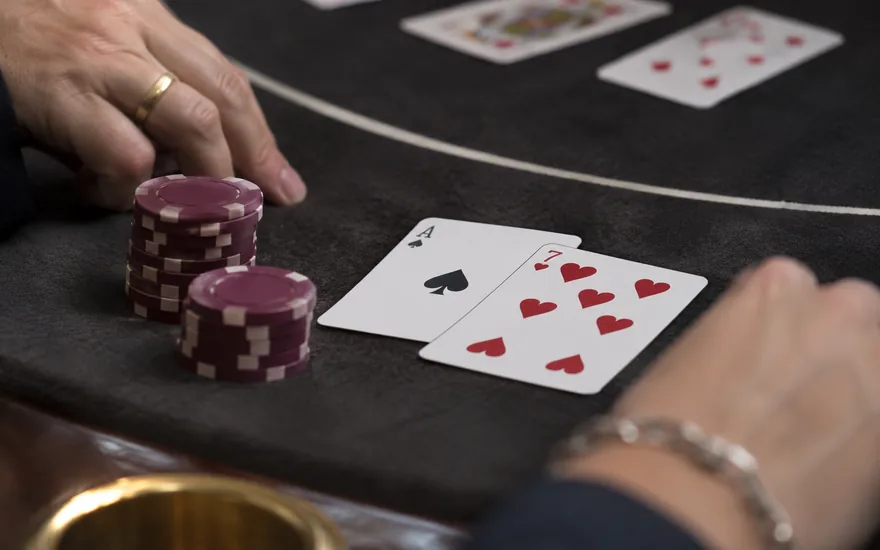
A soft 18 in blackjack contains an ace still counted as eleven, such as ace-seven. It is different from hard 18 or a pair of nines. The appropriate action depends on the dealer’s upcard, the rules and whether doubling remains available.
How do you identify a soft 18 in blackjack?
An ace can be valued as one or eleven when calculating a blackjack total. A hand is soft when an ace can still count as eleven without busting. Ace-seven is therefore a soft 18, while ten-eight is a hard 18 despite showing the same points total.
A three-card hand can also be soft. Ace-two-five has a value of eight or eighteen, so its best non-bust total is soft 18. The number of cards alone does not determine softness. It is the continuing ability to use an ace as eleven that matters.
Multiple aces need the same calculation. Ace-ace-six can total eighteen by valuing one ace as eleven and the other as one. Treating both as eleven would give an unusable twenty-eight. The useful total comes from the permitted values together, not from counting every ace in isolation.
By contrast, ace-seven-ten totals hard 18. The ace must now count as one because eleven plus seven plus ten would exceed 21. There is an ace in the hand, but it no longer supplies a usable eleven, so an instruction for soft 18 should not be applied to it.
| Cards | Best non-bust total | Classification |
|---|---|---|
| Ace, seven | 18 | Soft |
| Ace, two, five | 18 | Soft |
| Ten, eight | 18 | Hard |
| Ace, seven, ten | 18 | Hard |
| Nine, nine | 18 | Pair; use the appropriate rules |
Why hard 18 and a pair of nines need different rows
Strategy charts usually give hard totals, soft totals and pairs separate rows because those hands can offer different choices. Another card can also affect them differently. Reading ace-seven from the hard-18 row loses the ace information the model needs, even though the points total appears to match.
Likewise, nine-nine may allow a split under the table rules, while ace-seven does not form a pair. Two hands with the same displayed total can therefore present different choices. The chart must be read using both the hand’s structure and its total.
The dealer’s upcard supplies another input. A decision taken against seven cannot automatically be copied against an ace. The visible total describes the player’s cards; it does not summarise every possible dealer completion or the way the table treats a dealer natural.
Hit, stand and double are not interchangeable
Standing ends the player’s drawing decision at the current total. Hitting takes another card and requires the total to be recalculated. Doubling commits an additional stake under the applicable conditions, normally with a restricted continuation. The table’s rules determine whether that last option is available.
PlayOJO’s basic-strategy guide describes standing on soft 18 against seven or eight, hitting against nine, ten or ace, and doubling soft hands of eighteen or below against five or six. Those examples are conditional strategy descriptions, not promises of profit or a complete chart for every variant.
The same publisher’s chart guide separates single-, double- and multi-deck games and notes dealer-rule differences. Use a chart matching the actual rules rather than treating the examples above as a universal instruction. A changed deck composition or variant can require a different model entirely.
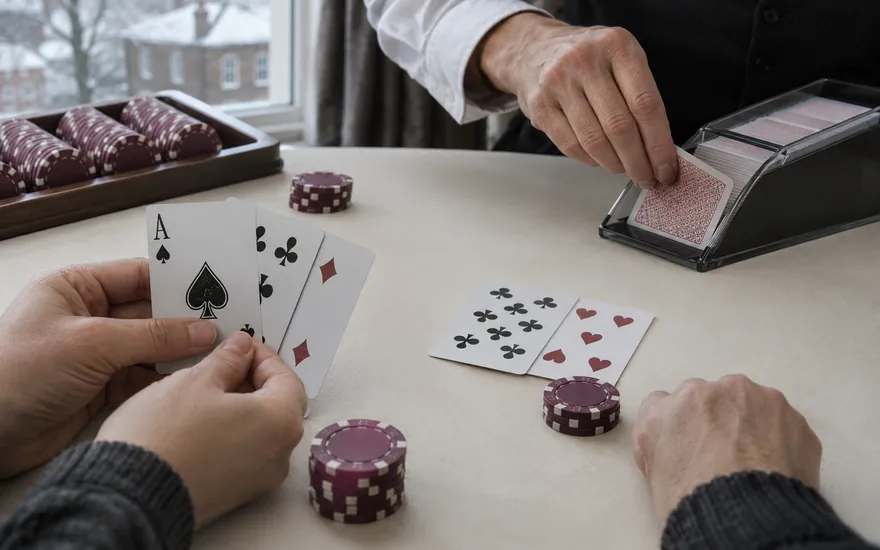
What happens when a two-card hand gains a third card?
Suppose an initial ace-two receives a five. The total becomes soft 18, but a table permitting doubling only on the original two cards may no longer allow that action. The fact that the new total matches ace-seven does not restore an option the rules have already closed.
This is an important reason to read a chart’s fallback notation. A square that recommends doubling may also specify whether to stand or hit if doubling is unavailable. Those fallback actions are not all the same, and a general rule to hit whenever doubling is blocked can be misleading.
For a multi-card soft 18, keep the dealer’s upcard and the remaining actions visible. Do not copy only the headline word double from a two-card example. The question after another draw is both what the hand now contains and what the version still permits.
Recalculate after every draw
Consider ace-seven followed by a two. The best total becomes soft 20. Followed instead by a ten-value card, ace-seven becomes hard 18 because the ace changes to one. The first draw cannot bust an initially soft total, but it can remove that flexibility from a later decision.
That distinction does not make hitting free of risk. A lower resulting total or a later hard hand can still lose. Saying that the first extra card cannot immediately bust soft 18 is an arithmetic observation about ace valuation, not a claim that another card must improve the outcome.
Use the same process with a longer hand. Ace-two-five is soft 18; adding a nine produces hard 17. The points total has fallen even though a card was added, because the ace’s usable value changed. A screenshot showing only a displayed total can hide that transition.
| Starting hand | Extra card | New total |
|---|---|---|
| Ace, seven | Two | Soft 20 |
| Ace, seven | Ten | Hard 18 |
| Ace, two, five | Nine | Hard 17 |
Player soft 18 is different from the dealer soft-17 rule
H17 and S17 describe the dealer’s required action on soft 17. They do not tell a player to copy the dealer’s behaviour on soft 18. The player’s choice and the dealer’s mandatory procedure are different parts of the rules.
A table may require the dealer to stand on soft 17 or to hit it. That affects the model used by a suitable chart, but it does not turn the player’s ace-seven into a different points total. Keep the hand definition separate from the assumptions governing the comparison of actions.
The blackjack RTP article explains why those assumptions belong beside a return percentage. If a summary omits them, a seemingly precise figure can be attached to a decision model that does not describe the table actually being considered.
Doubling changes the money exposed
Suppose a hypothetical table allows an equal double on a £2 stake. Committing another £2 brings the total main-hand stake to £4. That is the amount now exposed on the hand, not merely the initial amount. A chart’s recommendation neither reduces that commitment nor guarantees a winning result.
The initial amount and the combined amount should remain separate in any record. A returned stake is not the same as profit, and a credit after settlement can include both. Our payout explanation demonstrates the accounting distinction for natural blackjack without applying that payout to soft 18.
If the additional money would exceed an intended spending boundary, a mathematical chart is not a reason to increase that boundary. Understanding a conditional action does not create an obligation to take it. Choosing not to enter another round remains different from choosing between actions in a model.
When the displayed action seems inconsistent
Before assuming a fault, identify the complete hand, the dealer’s upcard and the point in the round. Check whether the hand followed a split or an earlier hit, and whether the rules restrict doubling. A greyed-out button can reflect an unavailable action rather than an incorrect hand total.
If something still appears wrong, retain the round identifier and the rules supplied with that version. Ask a precise question about the unavailable action or valuation. Avoid sharing personal account details publicly or trying to recreate the issue with further money at stake.
The rules notebook provides routes to other settlement questions, including the five-card condition. A long hand, a soft hand and a natural blackjack describe different properties. Keeping those labels distinct is the first step towards a useful explanation of the result.
Calculate the total before naming the decision
The soft label describes how an ace is currently valued. In ace-seven, counting the ace as eleven gives eighteen; counting it as one gives eight. The availability of that lower total is what distinguishes the hand from an ordinary hard eighteen.
Do not begin with a remembered instruction attached only to the number eighteen. First identify the actual cards and whether an ace can still count as eleven without exceeding twenty-one. Then identify the dealer’s upcard and the actions available at that stage of the hand.
For a reading exercise, write both possible ace totals before choosing the highest legal one. The exercise separates arithmetic from action selection. A correct total is necessary for finding the relevant rule or chart position, but it does not by itself establish which action a complete model prefers.
A screenshot can make this harder if it shows a combined label such as eight or eighteen without the explanation. Preserve the cards as well as the label. That gives another reader enough information to confirm the hand’s current state rather than guessing what the display intended.
An ace added to ace-seven needs two ace values
In the hypothetical hand ace-seven-ace, treating both aces as eleven would exceed twenty-one. One ace can still count as eleven while the other counts as one, producing nineteen. The new state is therefore not explained by adding eleven mechanically to the previous displayed total.
This example illustrates why every draw needs a fresh valuation. The earlier label was a description of the earlier cards. Once the hand changes, the relevant total and possibly the relevant chart row can change as well. The original soft-eighteen row is not a permanent instruction for the rest of the hand.
Recalculate from all the cards if another arrives. Having several aces does not mean that each can remain worth eleven independently of the total. Assign legal values across the complete hand, then find its highest non-bust total; the previous display cannot be carried forward without that calculation.
None of this arithmetic predicts the next card. It explains a recorded hand state. A reader can use it to understand a history entry without deciding to draw another card or treating an available lower total as protection against every possible later result.
A larger card can convert the hand into a hard total
Suppose ace-seven receives a four. With the ace at eleven, the total would be twenty-two, so the ace must instead count as one and the hand totals twelve. Its first two cards made soft eighteen, but that earlier description no longer identifies the hand after the new card.
This conversion explains why a game can display a lower total after another card arrives. The display is not subtracting an unexplained amount from the cards. It is using the ace’s alternative value to avoid counting a bust total where a lower legal total exists.
The next decision, if another decision is available, belongs to that newly calculated state. A statement about an initial soft hand should not be reused as though the four had changed nothing. The action choices also need to be read at the current stage, not assumed from the initial deal.
For a settlement or display enquiry, retain the sequence and both valuations. Asking why ace-seven-four is shown as twelve is a precise arithmetic question. Claiming that an eighteen was removed would describe the same transition in a misleading way and obscure the actual rule.
One non-busting draw does not establish the best action
The flexible ace value means that one additional card added to a two-card ace-seven can be valued without immediately exceeding twenty-one. That mathematical observation is narrower than a recommendation to draw. It does not compare the full consequences of drawing, standing or another available action.
A complete decision model considers the dealer upcard, the rules and the subsequent possibilities. Avoid replacing those inputs with one attractive statement about a single draw. An action can avoid an immediate bust and still need evaluation against the alternatives under the applicable model.
The distinction is useful when reading simplified advice. A phrase explaining why a soft hand differs from a hard hand may be accurate, while a universal instruction appended to it may omit deciding conditions. Keep the explanation and the claimed action separate until those conditions are identified.
This guide therefore does not present flexibility as a reason to continue a session or increase a stake. It is a feature of the card valuation. Understanding it does not change what money can be lost or create a guarantee about the final comparison with the dealer.
The dealer’s upcard is not the dealer’s completed hand
An upcard is the visible input available at the player’s decision stage. It does not reveal the dealer’s eventual total. A chart organised by upcard is therefore not claiming that the dealer already holds a particular completed hand behind every column.
In a record of a completed round, note the upcard visible when the player acted and record the dealer’s eventual hand separately. Substituting the final hand for the earlier upcard would give the decision information that was not available at the time. Keep the two stages distinct when checking the chart.
This is also why a single favourable or unfavourable outcome cannot prove that the earlier choice was correctly or incorrectly specified by a model. An outcome is one realised path. The decision rule concerns the information and possibilities available before that path completed.
When checking a published chart, identify its rule assumptions and the exact row and column. Do not judge its meaning solely by whether a recorded example happened to win. A retrospective result is not a substitute for the conditions the chart states it covers.
A disabled action can reflect the stage of the hand
An information panel may allow an action only under specified conditions. If the hand has already taken a card, a choice offered on the initial deal may no longer be available. The current control state should be interpreted against the actual version’s rules, not a general memory of another table.
Grosvenor’s published All Bets Blackjack RNG rules provide one concrete example of stage-specific doubling: its description distinguishes the initial two cards from a hand after a third card. That example demonstrates the need to check a version. It does not declare an identical condition for every blackjack product.
If a control is absent, identify whether the missing condition concerns card count, a split hand, an allowed total or another stated restriction. Do not automatically treat the interface as faulty or assume that adding money would enable the option. The rule question should be answered before any new transaction.
Retain the action sequence in a support note. A screenshot containing only the final cards may omit the earlier choice that changed availability. The complete sequence allows the operator to explain the control without requiring another hand to be played as a test.
A pair of nines belongs to a different classification
Two nines total eighteen, but neither card is an ace. The hand is therefore not soft. It is also a pair, which may introduce a split decision where the rules permit one. Those facts distinguish its reading from ace-seven even though both screens can prominently display eighteen.
Set ace-seven beside nine-nine in a hypothetical comparison. The first is soft; the second is a pair with a hard total. Even against the same dealer upcard, they need not use the same row of a matching chart, because the hands can have different options under the rules.
Do not merge the two under a headline rule about always standing on eighteen. Such a statement can conceal both the ace valuation and the pair classification. A useful explanation identifies the hand type before discussing the actions the actual rules make available.
The blackjack RTP page explains why these decision assumptions matter to a model. This article uses the comparison to identify the state, not to supply a universal instruction to split, stand or draw with an unidentified variant.
A split hand can carry additional restrictions
The origin of a hand can matter even after its visible cards resemble an ordinary initial hand. A version may define particular treatment after a split, especially when aces are involved. Those provisions belong to the exact game and should not be filled in from another product.
Compare an original ace-seven with a hand where a seven is dealt to an ace after a split. The totals can match, but the split rules may leave different follow-up actions available. This hypothetical comparison shows why a screenshot of the final cards might not explain the control state on its own.
Keep the parent round and the resulting hand identifiers where available. The additional stake and the card sequence can explain why a control differs between positions. A combined account credit is not enough to establish which individual hand had which options.
This is another reason to avoid treating a chart’s short action symbol as a complete explanation. The chart must cover the actual hand origin and available choices. Where the match is unconfirmed, preserve the uncertainty rather than claiming that the table should offer an action its rules may exclude.
A soft-hand explanation is separate from money management
An ace’s flexible value changes the way cards are counted. It does not make a larger stake affordable, insure a session against loss or convert gambling into a reliable source of money. The arithmetic should not be used to justify exposing more than a reader intended.
Keep the hand description and money record separate when reviewing a round. Doubling, where permitted, can commit more money, and splitting can introduce another stake. An ace’s lower alternative value changes the total used to assess the cards; it does not cancel any of those additional stake entries.
If the question is whether a balance can be withdrawn, the soft-hand label supplies no answer. A completed game credit and an outgoing transfer have different records. The payment routes identify the evidence relevant to the cashier stage rather than the card-total calculation.
If play has become an attempt to recover earlier losses, use independent support instead of searching for a more reassuring hand category. A mathematically flexible total does not remove uncertainty from the eventual result or repair a financial commitment already made.
Record the decision state before reviewing its result
A useful soft-eighteen record contains the cards, their order, the dealer upcard, the applicable dealer rule, the player options available and the action actually recorded. Add the final settlement afterwards. This keeps the information available at the decision point separate from knowledge obtained later.
For a rules question, attach the exact information-panel passage or the source of the chart being interpreted. A comment that a hand looked strong does not identify the governing condition. Neither does a result alone establish whether the published chart and the actual variant matched.
If support explains that a hand changed from soft to hard, reproduce the ace valuation explicitly. If it explains that an action was restricted after a split or draw, preserve the sequence which triggered that restriction. A clear explanation can resolve an apparent inconsistency without any new paid play.
The question is answered when the hand is correctly identified and the relevant rule can be explained for that case. That does not mean every soft eighteen should be handled alike. One remembered action cannot cover every table, and understanding a chart still cannot guarantee the result of a session.
Questions that follow
What is soft 18 in blackjack?
A total of eighteen with an ace still usable as eleven, for example ace-seven or ace-two-five.
Is ace-seven the same as ten-eight?
No. The first is soft and the second hard, so they can require different chart rows.
Should I always stand on soft 18?
No universal action applies. The dealer’s upcard, rules and available options matter.
Can a three-card hand be soft 18?
Yes. Ace-two-five is an example, although the rules may no longer permit doubling after a draw.
Does H17 tell a player to hit soft 18?
No. H17 describes the dealer’s mandatory behaviour on soft seventeen.
Sources & review
Published-source references, with check dates where recorded. No personal deposits, withdrawals or gameplay tests are claimed. Images illustrate the subject; they are not evidence of a tested account.